
Hazardous Area Classification (Ex Zones)
Hazardous area classification defines where explosive atmospheres can occur and how likely they are — the zones that drive every equipment and inspection decision downstream. Clear, defensible and standard-based, for gas, vapour and dust.
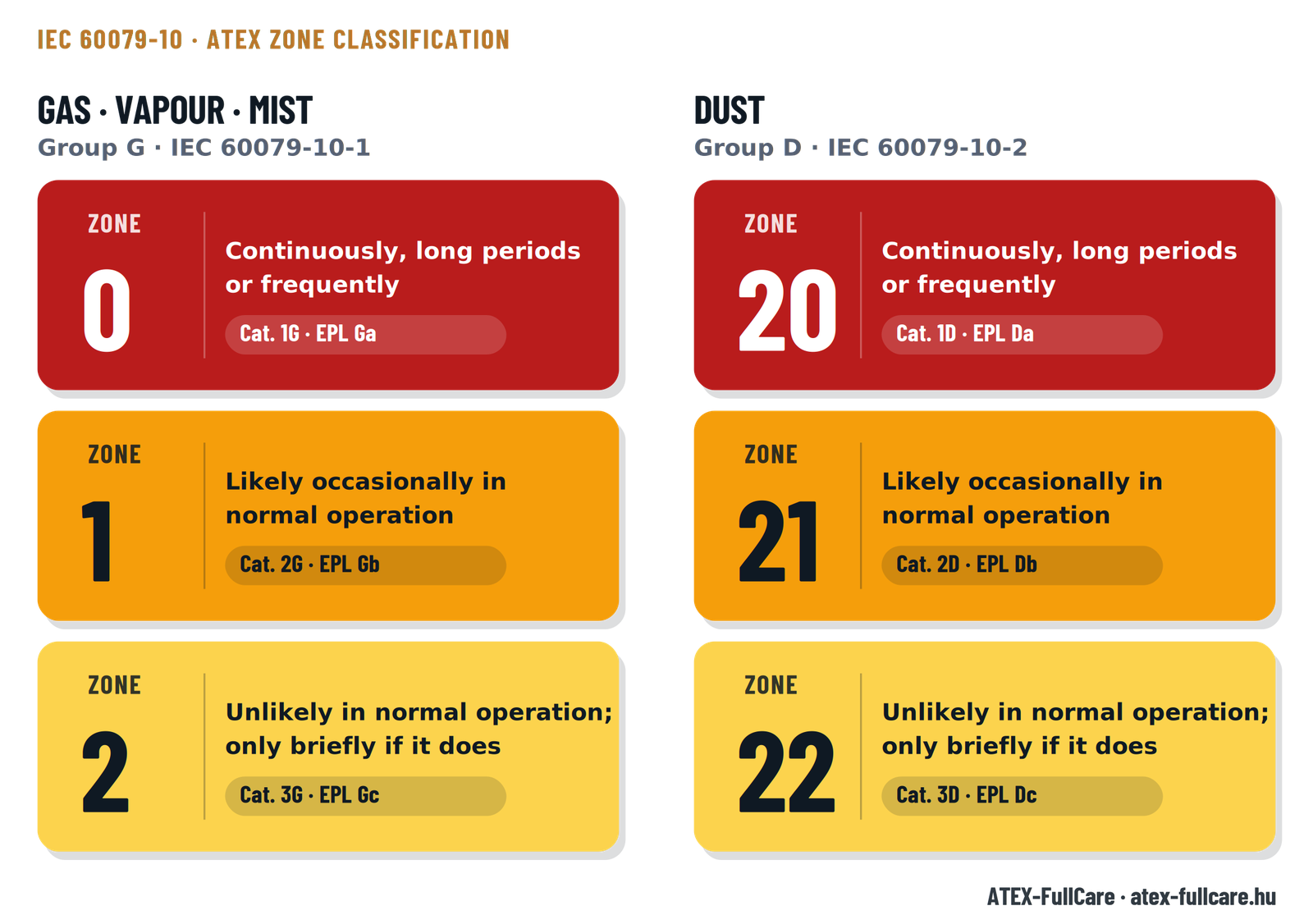
What is hazardous area classification?
Hazardous area classification identifies the places where a flammable gas, vapour, mist or combustible dust can form an explosive atmosphere, and grades them into zones by how likely and how long that atmosphere is present. It is the foundation for correct Ex equipment selection, for the explosion protection document, and for a meaningful Ex inspection.
Gas and dust zones
Gas & vapour
- Zone 0 — explosive atmosphere present continuously or for long periods
- Zone 1 — likely to occur in normal operation
- Zone 2 — not likely, and only for short periods if it does
Combustible dust
- Zone 20 — dust cloud present continuously or for long periods
- Zone 21 — likely in normal operation
- Zone 22 — not likely, short duration
New to zones? See what is a hazardous area.
How classification is done
Sources of release
Identify where flammable material can escape — grade (continuous, primary, secondary), rate and the substance properties.
Ventilation & dispersion
Assess ventilation type and availability; this strongly affects the extent and grade of each zone.
Zones & drawings
Determine zone type and extent, and record it on classification drawings and a schedule that others can use.
When you need (re)classification
- No current classification, or it no longer matches the plant.
- New or changed technology, materials, throughput or ventilation.
- Before preparing or updating the explosion protection document.
- When inspection findings suggest equipment and zones no longer align.

Request a hazardous area classification quote
Tell me the substances, the process and whether existing drawings exist. I will advise whether a review or a full classification is needed, and provide a quote.
Independent CompEx certified inspection and explosion protection support. Final scope and fee are agreed individually. Email: info@atexfullcare.com.
Frequently asked questions
Is classification the same as an EPD?
No. Classification defines the zones; the explosion protection document is the wider assessment that uses those zones. They are related but separate deliverables.
Which standard is used?
Gas classification follows IEC/EN 60079-10-1 and dust IEC/EN 60079-10-2, applied to your specific substances and process.
Do you also inspect to the classification afterwards?
Yes — classification and Ex inspection fit together; the zones define what equipment is acceptable and how it is inspected.
What do I actually receive?
Classification drawings showing the type and extent of each zone, a schedule of the sources of release, and a short report explaining the basis — everything downstream equipment selection, the EPD and inspection can rely on.
How often should the classification be reviewed?
It is a living document: review it whenever the technology, materials, throughput or ventilation change, and periodically otherwise, so the zones still match the plant.
Who should carry out hazardous area classification?
A competent person who combines process knowledge with Ex expertise and applies IEC/EN 60079-10-1 (gas) and -10-2 (dust) — and keeps it consistent with the explosion protection document and the inspection regime.