🏭 ATEX · Food Industry · Dust Explosion Protection

ATEX Compliance for the
Food Industry — Dust Is the Hazard

Flour, sugar, starch, cocoa, spice — fine organic dusts are explosive, and food processing facilities are full of them. Zone 20/21/22 classification, Ex equipment inspection, and EPD preparation for food and beverage manufacturers across Europe.

EN/IEC 60079-10-2 (Combustible Dust) Zone 20 / 21 / 22 ATEX Directive 2014/34/EU Workplace Directive 1999/92/EC
Request a Free Assessment →
≥125g/m³ — typical MEC of
flour dust (minimum explosive conc.)
3Dust zone categories:
Zone 20 / 21 / 22
St1–3Dust explosion classes —
food dusts are typically St1 or St2
EUOn-site & remote service
across Europe

Most Food Facilities Have Dust Explosion Hazards — Many Don't Know It

Organic dusts from food processing are explosive. A dust cloud at the right concentration, encountering any ignition source, can produce a primary explosion — and the pressure wave can suspend settled dust to create a far more destructive secondary explosion.

  • Flour, sugar, starch, cocoa, coffee, spice, and milk powder are all classified as combustible dusts
  • ATEX Directive 1999/92/EC applies equally to dust and gas — food facilities are not exempt
  • Zone 20/21/22 classification is mandatory wherever combustible dust can form an explosive cloud
  • Ex equipment is required in classified dust zones — standard IP-rated equipment is not sufficient
  • Dust layers on surfaces are a secondary explosion risk — cleaning regimes are part of ATEX compliance
  • Many food facilities also handle cleaning solvents or flavour extracts — creating combined gas and dust hazards
⚠️ Why Dust Explosions Are Underestimated

Invisibility. Fine dust particles are not always visible in the air. Concentrations above the MEC (minimum explosive concentration) can exist in equipment and enclosed spaces without obvious signs.

Secondary explosions are the killer. A small primary explosion — even a contained one — sends a pressure wave through the facility, suspending settled dust on horizontal surfaces. The secondary explosion is typically 5–10 times more powerful.

Common ignition sources in food plants: hot bearings, friction from conveyor belts, static discharge during pneumatic transfer, overheated electrical equipment, welding and grinding without hot work permits.

Temperature class matters. Dust has a lower explosive limit and a layer ignition temperature — both must be checked against T-class of installed Ex equipment.


Where Dust Zones Are Found in Food Facilities

Every food processing operation is different, but the locations below appear in the majority of facilities and are frequently unclassified or incorrectly classified.

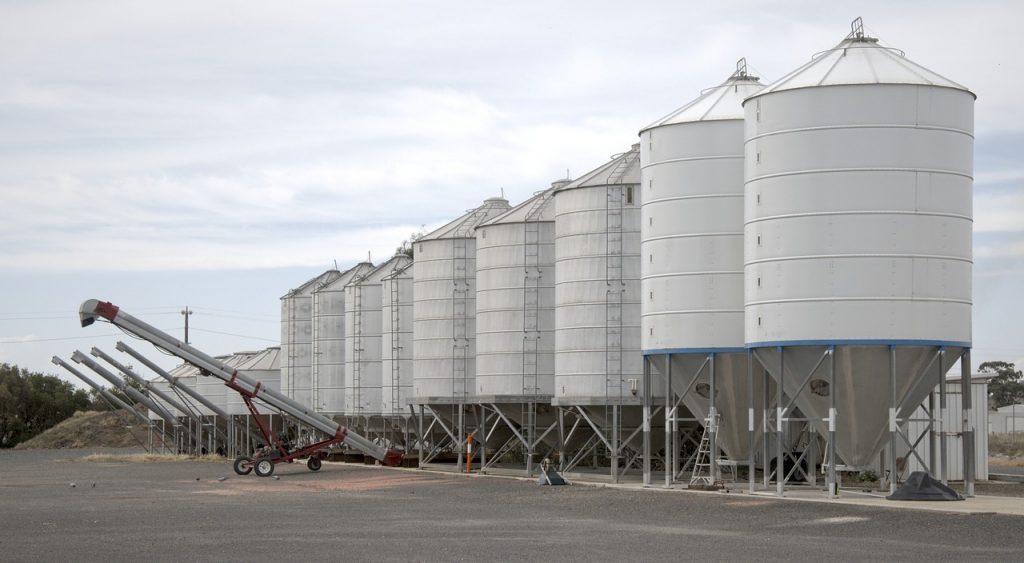
Silos & Storage Bins
Typically Zone 20 (interior) / Zone 21 (venting area)
Interior of silos handling flour, sugar, starch, or grain — Zone 20 due to continuous dust cloud presence. Venting outlets and fill connections — Zone 21 during filling operations.
Pneumatic Conveying Systems
Typically Zone 20 (pipework interior) / Zone 21 (transfer points)
Inside pneumatic lines — Zone 20. At bag dump stations, cyclone separators, and filter receivers — Zone 21 during operation. High static discharge risk from non-conductive pipework.
Dust Collection Systems & Filters
Typically Zone 20/21 (interior) / Zone 22 (exterior cleaning area)
Filter interiors where dust concentrations are continuously elevated — Zone 20. Pulse-jet cleaning generates temporary clouds — exterior classified Zone 22 if dust layer accumulation occurs.
Milling & Grinding Areas
Typically Zone 21 (direct area) / Zone 22 (surrounding area)
Dust cloud generated continuously at the mill outlet. Zone 21 in the immediate area. Zone 22 in the surrounding room if general ventilation is insufficient to prevent dust layer build-up.
Packaging & Filling Stations
Typically Zone 21 (at fill point) / Zone 22 (general area)
Open bag filling and powder dosing create dust clouds during normal operation. Zone 21 at the fill point. Zone 22 for the general packaging hall if dust emission is regular and ventilation is limited.
Dryers & Spray Dryers
Typically Zone 20 (interior) / Zone 21 (discharge area)
Interior of spray dryers handling milk powder, coffee, or starch — Zone 20 continuously. Product discharge area and cyclone below dryer — Zone 21 during normal operation.

Common Food Industry Dusts — Explosion Properties

The explosion class and ignition temperature of the specific dust handled determines the required equipment T-class and Ex category. Generic classifications are not sufficient.

Substance Explosion Class MEC (g/m³) Layer Ignition Temp. Required T-class (indicative)
Wheat flour St1 ~50 ~290°C T3 minimum — verify per actual dust data
Sugar (fine) St1 ~30 ~370°C T3 minimum — check layer temp vs. T-class
Corn starch St2 ~40 ~280°C T3 — higher explosion index than flour
Cocoa powder St1 ~65 ~225°C T4 — lower layer ignition temp requires attention
Milk powder St1 ~60 ~200°C T4/T5 — verify: fat content affects ignition temp
Ground pepper / spice St1 ~30–80 Variable Verify per specific substance — wide variation
Instant coffee St2 ~85 ~170°C T5 or T6 — critical: very low layer ignition temp

⚠ Values are indicative reference data. Actual explosion properties vary with particle size, moisture content, and dust composition. Always use certified test data for your specific material.

The Most Common ATEX Failures in Food Facilities

No dust zone classification at all The majority of SME food manufacturers have no formal dust zone classification. Flour mills, bakeries, and spice processors frequently operate with no zoning, no Ex equipment, and no EPD.
Standard IP-rated motors in Zone 21 areas High-protection IP equipment is not Ex equipment. IP66 does not mean explosion-proof. Non-Ex motors installed at silos, conveyors, and dust collectors are one of the most frequent critical non-conformities found.
Wrong T-class for the dust handled Equipment with T3 rating installed where the dust has a layer ignition temperature of 200°C — requiring T4 or T5. The equipment surface can ignite the dust layer during normal operation.
Dust layers ignored as an ignition source Settled dust on flat surfaces (motor housings, lighting fixtures, structural beams) above the MIE threshold — without a documented cleaning regime and without assessment as an ignition source in the risk assessment.
Non-conductive pneumatic pipework — no earthing Plastic or ungrounded metal pipework in pneumatic transfer systems generates static charge. Without earthing and bonding, static discharge into the dust cloud is a credible ignition source.
Hot work in dust areas without proper permits Grinding, welding, or cutting near dust-handling equipment without a documented hot work permit, area isolation, and dust suppression — a frequent cause of primary ignition events in food facilities.

Full ATEX Compliance for Your Food Facility

From initial site assessment through to complete documentation — a structured programme that brings your facility into compliance without disrupting production.

🔍
Initial ATEX Assessment

On-site or remote review of your facility, substances handled, and existing documentation. A clear picture of what zones are likely to exist, what equipment is at risk, and what documentation is missing.

🗺️
Dust Zone Classification

Zone 20/21/22 classification per EN/IEC 60079-10-2 for all dust-handling areas. Zone drawings produced and integrated into the EPD. Substance explosion data assessed and documented.

📄
EPD Preparation & Update

Complete Explosion Protection Document prepared per Directive 1999/92/EC — including dust risk assessment, zone drawings, equipment register, and protective measures documentation.

🔍
Ex Equipment Inspection

Periodic inspection of all Ex-rated equipment in dust zones per EN/IEC 60079-17. Written inspection report with non-conformity register and recommended corrective actions.

🔧
Equipment Selection Guidance

Specification of Ex equipment appropriate for the dust zone, explosion class, and T-class required. Practical guidance for replacement of non-compliant equipment during planned maintenance.

💬
Online Consultation

30–60 minute video call to review your situation, answer technical questions, or provide a second opinion on classifications or equipment choices. No travel cost, available EU-wide.

Handle Flour, Sugar, or Powder? Let's Check Your Zones.

Start with a free 30-minute online assessment. Describe your facility and substances — and I'll tell you what ATEX compliance scope you need and what it will cost.

↓ Fill in the form below — response within 1 business day

Name
Privacy Policy
Scroll to Top